



Shadow AI security means finding and governing the AI tools, assistants, extensions and agents that employees use without IT approval. Most companies have a bigger AI footprint than their IT team can see, and data can leave through every unmanaged channel. A simple framework helps: see what AI is in use, control what’s allowed, protect against misuse, and prove it with reporting.
Key takeaways
✓ More than 45% of employees are reported to use AI, and a lot of that use sits outside IT’s view.
✓ Security and risk concerns are reported as the number one barrier to scaling AI programs.
✓ Companies with a structured cybersecurity program see AI initiatives move about 20% faster.
✓ See, control and protect, then prove gives MSPs a conversation starter and a service roadmap.
Introduction
Every company has an AI transformation program. Some planned theirs. Many didn’t.
A finance team runs a report through a public chatbot. A sales executive installs an AI browser extension that IT never approved. A project team adopts a software tool with generative AI built in. The train, as WithSecure’s Suvi Silvanto put it at a recent MSP event, has already left the platform.
Your clients feel this, even if they phrase it differently: „I don’t know what my employees are doing with AI, but I know they’re using their personal assistants. Are we safe? Are we leaking data?“
This article gives you a plain framework to answer those questions and turn them into a managed service.
In this article, you’ll learn:
- What shadow AI is and where it hides
- Why security is holding AI programs back, and how to change that
- A four-step framework for securing AI in mid-sized companies
What is shadow AI, and why is it a security risk?
Shadow AI is any use of AI tools, assistants, plug-ins or agents that sits outside the organization’s approved and monitored environment. It’s a risk because data, credentials and decisions pass through channels that nobody governs.
We call the picture an „AIsberg.“ Above the waterline sits what IT can see: sanctioned tools and official rollouts. Below it sits a much larger mass:
- Personal AI assistants used for work tasks.
- Browser extensions with broad access to pages and data.
- Software with embedded generative AI that arrived through a routine update.
- AI agents that may hold more privileges than the human users who launched them.
The concern is data leaving through these channels. It’s also the question of who, or what, has permission to do what. An agent with wide access and no oversight is an identity problem as much as an AI problem.
Key points
- Usage is uneven. In some firms two people produce reports for everyone, while others already run AI inside their processes.
- Either way, every company needs visibility, guardrails and governance.
- AI security is becoming a discipline of its own.
Why is security the barrier to scaling AI?
Security concerns slow adoption
Leaders want the productivity and growth AI promises. Teams across the business are exploring how to apply it. Yet security and risk concerns are reported as the leading barrier to scaling AI programs. It isn’t a lack of ambition or budget. It’s a lack of confidence.
Structure speeds things up
Companies that put a structured cybersecurity program in place move AI initiatives about 20% faster. Clear rules and visibility remove the hesitation. Teams know what’s allowed, so they can start.
Security can’t be the bottleneck. It can be the reason a company moves with confidence.
That’s what your clients are really asking for, even when they don’t say it: confidence that they can start an agentic process somewhere, and that they’re safe when they do.
How do you secure AI usage? The see, control, protect, prove framework
Use these four steps as a conversation guide. Each step may involve a different person at the client.
- See: what AI is being used? Find out which tools are running, who uses them, with what permissions and credentials, and what data they touch. Include the sanctioned and unsanctioned. This step alone builds confidence, because it replaces guesses with a concrete picture.
- Control: what is allowed? Define policies. Which tools are approved? What data can go where? What can an agent do on its own? Control means clear rules, written down and enforced.
- Protect: how do we defend the business? Put guardrails in place and prepare dynamic, fast response. If an agent behaves unexpectedly or data starts to leak, the response should be quick and automatic where it can be.
- Prove: can you show it? Report on risk and posture continuously. Show leadership and auditors that the environment, AI and traditional IT alike, is under control. Proof turns security work into something the business can see.
The framework works because it’s simple. A CEO, an IT lead and an AI transformation team can each find their question in it.
Common challenges and solutions
| Challenge | Solution | WithSecure approach |
|---|---|---|
| IT can’t see personal assistants, extensions or embedded AI | Run an AI discovery and risk assessment | Start with visibility across identities, cloud and endpoints in a unified platform |
| Agents hold broad privileges | Treat agents as identities with least-privilege access | Identity and cloud security alongside endpoint protection show who and what has access |
| Policies exist on paper only | Pair policy with technical guardrails | Proactive security links detection, exposure and response so rules are enforced, not just written |
| Leadership wants evidence | Report posture and risk continuously | Risk reporting built for business conversations |
Frequently asked questions
Q: What is shadow AI? Shadow AI is the use of AI tools, such as personal assistants, browser extensions, embedded generative AI features and agents, without IT approval or oversight. It creates blind spots where data, credentials and permissions are unmanaged and may leave the organization.
Q: How common is AI use among employees? Reports indicate more than 45% of employees use AI. The figure varies widely. Some companies have a couple of people using AI for reporting, while others have AI embedded in their processes. Every company still needs visibility and governance.
Q: How do you secure AI in a company? Start by seeing which AI tools, users and permissions exist. Then define what is allowed, protect with guardrails and fast response, and prove control through continuous reporting. This see, control, protect, prove model works for both AI and traditional IT.
Q: Does AI security slow down innovation? It shouldn’t. Security concerns are currently the top reported barrier to scaling AI, while companies with structured cybersecurity programs move AI initiatives about 20% faster. Clear rules and visibility give teams confidence to proceed.
Conclusion
AI is already inside your clients‘ organizations. Some of it is approved. A lot of it isn’t.
You don’t need to start with a large program. Start by showing what’s below the waterline. Then work through control, protection and proof. That path builds confidence for your clients, and it builds a service for you.
Watch now: Proactive Security in the AI World: How MSPs Build New Services
Blog post
Read our latest blogs

Blog
Blog
Blog
Proactive Security: How MSPs can keep up with a 29-minute attack

Attack surface management is the continuous process of discovering, mapping and reducing every way an attacker could get into an organization. More than 70% of attacks now start somewhere other than the endpoint: in identity, cloud misconfiguration or a firewall, and then move to endpoints later. Mid-sized companies and their MSPs need visibility across all of it, because the surface changes every day.
Key takeaways
✓ More than 70% of attacks begin outside the endpoint, then reach endpoints later.
✓ In a WithSecure survey of about 500 mid-sized European companies, every respondent said they no longer know their full attack surface.
✓ The surface shifts daily with new configurations, new software and new cloud services.
✓ MSPs that add exposure visibility to protection create a service clients can see and value.
Introduction
If you sell endpoint protection alone, you’re protecting where attacks often end, not where they start.
Endpoint security remains essential. But the picture of how attacks unfold has changed. Attackers look for the easiest way in: a stolen credential, a cloud storage bucket left open, a firewall rule nobody reviewed. Once inside, they move toward endpoints and data.
For MSPs, this creates both a gap and an opportunity. Clients assume „we have antivirus“ means „we’re covered.“ You know it doesn’t. The question is how to help them see what they can’t see today, and how to turn that into a service.
In this article, you’ll learn:
- Where attacks really begin and why that shift matters
- Why mid-sized companies struggle to know their attack surface
- A practical way to build attack surface visibility into your services
Where do most attacks start if not at the endpoint?
More than 70% of attacks start in identity, cloud misconfiguration, firewalls or other parts of the environment, and only then move to endpoints. The endpoint is often the second or third step in the story.
Common entry points include:
- Identity. Compromised or over-privileged accounts, weak multi-factor coverage, forgotten service accounts.
- Cloud. Misconfigured storage, exposed services, permissive access policies.
- Network edge. Firewalls with outdated rules or unpatched firmware.
- Software and third parties. Unapproved applications, unpatched components, supplier access.
By the time an endpoint alert fires, the attacker may already have done the groundwork elsewhere. And with lateral movement possible within 29 minutes of first compromise, that groundwork pays off quickly.
Key points
- Endpoint detection catches what reaches the endpoint. It can’t prevent a weakness it can’t see.
- Identity and cloud are now primary entry paths, not side concerns.
- Defense needs to span the whole environment, not one layer of it.
Why don’t mid-sized companies know their attack surface?
The surface changes every day
A year ago, WithSecure surveyed around 500 mid-sized companies across Europe. Every one of them reported the same reality: they no longer know their attack surface, because it changes constantly.
It’s easy to see why. Every day, someone changes a configuration. Someone uploads new software. A team spins up a cloud service for a project. A supplier gets access. None of these steps is unusual, and each one reshapes the surface.
Resources don’t match the risk
Small and mid-sized companies face the same threats as large enterprises. Ransomware groups and malware authors don’t discriminate by headcount, and they now use AI tools to find weaknesses faster.
Yet these companies are reported to be twice as likely to describe their cyber resilience as insufficient. They lack the large security teams that enterprises use to track exposure. That doesn’t mean they need a scaled-down enterprise product. They need enterprise-level expertise, in a solution designed for how they actually operate.
That gap is the business opportunity for MSPs.
How can MSPs build attack surface management into their services?
Follow these steps to move from protecting devices to managing exposure.
- Start with discovery. Build an inventory across devices, identities, cloud resources and software. Include what clients don’t know they have.
- Prioritize by real risk. Not every finding deserves attention today. Rank by exploitability and business impact so you fix what matters first.
- Close the gaps dynamically. When a new CVE or misconfiguration appears, mitigate within the client’s environment quickly rather than waiting for a scheduled review. Proactive security is a constant loop of scanning and mitigating before anything becomes a threat.
- Keep one view. Use a platform that covers endpoint, identity, cloud and collaboration together. Separate consoles hide the connections attackers use.
- Report the change. Show clients how their exposure shrinks over time. A visible risk trend turns an invisible service into one clients renew.
- Package it. Move from one-off assessments to a recurring exposure management service. From there, advisory work and virtual CISO (vCISO) retainers become natural next steps.
Common challenges and solutions
| Challenge | Solution | WithSecure approach |
|---|---|---|
| Clients believe antivirus equals full protection | Show where attacks actually begin with a baseline exposure view | Exposure Management in Elements gives partners a clear, visual starting point for the conversation |
| Attack surface changes daily | Replace periodic scans with continuous discovery | Continuous scanning inside a unified platform keeps the picture current |
| Identity and cloud sit in separate tools | Cover identity and cloud security alongside endpoint | Elements combines endpoint, identity, cloud and collaboration protection in one console |
| Small teams can’t triage every finding | Prioritize automatically and explain next steps in plain language | Contextualized findings and Luminen™ GenAI remediation guidance reduce manual work |
Frequently asked questions
Q: What is attack surface management? Attack surface management is the continuous process of discovering, mapping, prioritizing and reducing all the ways an attacker could reach an organization. It covers devices, identities, cloud services, networks and software, and it updates as the environment changes.
Q: Where do most cyberattacks start? More than 70% of attacks start somewhere other than the endpoint. Typical starting points include identity weaknesses, cloud misconfiguration and firewalls. Attackers then move to endpoints and data later in the attack, which is why endpoint protection alone leaves gaps.
Q: Is endpoint protection still necessary? Yes. Endpoint protection remains a core layer because attacks eventually reach endpoints. It is no longer sufficient on its own. It works best as one part of a unified approach that also covers identity, cloud and exposure visibility.
Q: How does attack surface management help an MSP grow? It gives MSPs a visible, recurring service beyond endpoint protection. Exposure reports start conversations with clients, support higher-value bundles and create a path toward compliance services and vCISO retainers, all on one platform.
Conclusion
The attack surface is no longer a fixed perimeter. It’s a moving target that changes with every configuration and every new tool. Most attacks begin where endpoint protection doesn’t look.
That’s a gap your clients can’t close alone. You can close it with them: discover, prioritize, mitigate and show the result. Start with a baseline view of exposure, make it a standing service, and grow from there.
Watch now: Proactive Security in the AI World: How MSPs Build New Services
Blog post
Read our latest blogs
Blog
Blog
Blog
Proactive Security: How MSPs can keep up with a 29-minute attack

Proactive security is a continuous loop of finding, prioritizing and fixing exposure before an attacker uses it, backed by response that runs at machine speed. Attackers now move laterally within 29 minutes of the first compromise. Rule-based playbooks and human-only monitoring can’t match that clock. MSPs need a unified, increasingly agentic approach that scans and mitigates continuously.
Key takeaways
✓ Lateral movement can start 29 minutes after the first attack, faster than most manual response processes.
✓ Proactive security is a whole loop (discover, prioritize, mitigate, respond), not just exposure management.
✓ Fragmented tools slow that loop down. Unified platforms keep it inside the attacker’s clock.
✓ Agentic security automates the repeatable work so your people focus on decisions that matter.
Introduction
Twenty-nine minutes. That’s roughly one team meeting, and it’s how long attackers now need to go from a first foothold to moving laterally through a client’s systems.
For MSPs, that number changes the conversation. Security built on rules, written into a playbook and watched by a human, was designed for a slower threat. The attackers it was built to stop now use AI tools too. A weakness that went unsolved by human attackers for 20 years can now fall in seconds, as one panel at a recent MSP event noted.
This article explains what proactive security means in practice, why a single exposure tool isn’t enough, and how MSPs can build a service that moves at the speed of the threat. It draws on WithSecure’s session for MSPs on building new services in the age of AI.
In this article, you’ll learn:
- Why response time is now the first thing clients should ask about
- What a complete proactive security loop contains
- How to move from reactive alert handling to continuous mitigation
Why is a 29-minute attack window a problem for MSPs?
A 29-minute window means any security process that depends on a person reading an alert, finding a playbook and acting will often finish after the attacker has already spread. Speed has become the first dimension of risk.
Most security operations were built around a familiar rhythm: an alert fires, an analyst triages it, a runbook guides the response. That works when attackers are slow. It struggles when the interval between first access and lateral movement is shorter than a shift handover, a ticket queue or a lunch break.
Three pressures make this harder for MSPs:
- Small and mid-sized businesses are now the main target. Cyber criminals don’t discriminate. Small manufacturers, logistics companies and universities face the same ransomware gangs and malware as large enterprises.
- Attackers have AI tools. Same threats, now with faster discovery, faster exploitation and faster iteration.
- Clients have fewer resources. Small and mid-sized companies are reported to be twice as likely to describe their cyber resilience as insufficient.
Key points
- Speed is the new baseline. Detection that is accurate but slow still loses.
- Rules and playbooks remain useful, but they need automation behind them.
- Your clients need enterprise-level expertise designed for their scale, not enterprise tooling shrunk down.
That last point matters. Mid-sized companies don’t need a scaled-down version of an enterprise stack. They need enterprise-level expertise in a form they can actually run.
What does proactive security actually include?
It is more than exposure management
Many vendors use „proactive“ to mean exposure management: finding vulnerabilities and misconfigurations before attackers do. That’s a vital part, but it’s one part.
At WithSecure, proactive security is the whole loop. It covers:
- Discovering assets, identities, cloud resources and software, including the ones nobody logged.
- Prioritizing exposure by real risk, not by raw severity scores.
- Mitigating weaknesses, ideally dynamically and without waiting for a maintenance window.
- Detecting and responding when something gets through anyway.
The loop never stops. When a new CVE (Common Vulnerabilities and Exposures) entry is published or a new asset appears, the cycle runs again.
Why the loop must live in one place
These steps used to sit in different tools, run by different teams, producing different reports. At a 29-minute clock, every handoff between tools costs minutes you don’t have.
When discovery, prioritization, mitigation and response share one platform and one data model, a newly published CVE can be matched to a client’s real exposure and mitigated within that client’s environment. No export, no ticket, no waiting for someone to reconcile three dashboards.
This is the design logic behind WithSecure Elements: a unified, multi-tenant platform that covers endpoint, identity, cloud, collaboration, exposure management and AI-powered managed detection and response (MDR) through one console and one lightweight agent.
Why must security become agentic?
Agentic security means software agents carry out defined security tasks, such as triage, enrichment, prioritization and containment, within guardrails that people set. It matters because human attention is the scarcest resource in any security operation.
The goal isn’t to remove people. It’s to let automation take the night shift, while experts handle judgment calls.
What agentic security does well
- Filters and contextualizes alert noise before a human sees it.
- Connects findings across endpoint, identity and cloud to show the whole attack path.
- Suggests or applies mitigation the moment a weakness is confirmed.
What people still do
- Set the policy and risk appetite for each client.
- Decide on high-impact actions.
- Talk to clients about what happened and what to change.
For a lean MSP team, this split is what makes 24/7 coverage realistic. WithSecure also delivers monitoring through its Co-security model, so partners don’t need to build their own security operations center (SOC). Your team keeps the client relationship. Our experts extend your coverage.
How to build a proactive service that keeps pace
Here is a practical path for MSPs starting from a traditional detection and response offering.
- Measure your own clock. Track the time from detection to containment for recent incidents. If it’s measured in hours, find where the minutes go: triage queue, tool switching, approvals.
- Consolidate the loop. Map the tools involved in discovering, prioritizing, mitigating and responding. Every separate console adds friction. Look for a platform where these functions share data natively.
- Automate the repeatable. Start with the actions you’d always take: isolating a host, blocking a known-bad indicator, applying a known fix. Let agents run those inside clear policy limits.
- Add continuous exposure visibility. Move from periodic scans to a constant view of each client’s exposure. The aim is to close the door before anyone tries the handle.
- Report in business terms. Show clients reduced exposure and faster response. Outcomes, not dashboards, keep partners and their clients confident.
Common challenges and solutions
| Challenge | Solution | WithSecure approach |
| Manual response can’t match a 29-minute window | Automate containment and mitigation within policy | Elements combines detection, exposure management and response, with expert MDR when your team is off shift |
| Tool sprawl slows every handoff | Consolidate onto a unified platform | One console and one lightweight agent across endpoint, identity, cloud and collaboration |
| Alert noise overloads small teams | Filter and contextualize before escalation | Elements prioritizes automatically, and Luminen™ GenAI gives clear remediation guidance |
| Clients can’t see what they’re protected against | Show exposure and risk in plain language | Risk reporting designed for client and board conversations |
Frequently asked questions
Q: What is proactive security? Proactive security is a continuous loop of discovering, prioritizing and mitigating exposure before attackers exploit it, combined with fast detection and response. It goes beyond exposure management to cover the full cycle, so weaknesses are fixed and incidents are contained at machine speed.
Q: How fast do attackers move after the first compromise? Attackers can now move laterally within 29 minutes of the first attack. That is faster than most manual, playbook-driven response processes, which is why automation and unified tooling are becoming essential for security services.
Q: What does agentic security mean? Agentic security uses software agents to perform defined tasks, such as triage, prioritization and containment, inside guardrails set by people. It reduces response time and alert fatigue, and it lets human experts concentrate on decisions and client conversations.
Q: Do MSPs need their own SOC to offer proactive security? No. MSPs can combine a unified platform with a Co-security model, where the vendor’s experts provide 24/7 monitoring and response. The MSP keeps the client relationship and revenue while avoiding the cost of building and staffing a SOC.
Conclusion
Attackers have AI. They move in 29 minutes. Your clients, many of them small and mid-sized businesses, are their targets. That’s the reality, and it isn’t going away.
The good news is that the answer is concrete. Run the full proactive loop. Keep it in one platform. Let automation handle the repeatable work and let your people advise. That’s how you stay inside the attacker’s clock, and how you build a service clients value.
Watch now: Proactive Security in the AI World: How MSPs Build New Services
Fast onboarding, faster security outcomes
Most cybersecurity platforms are built for enterprises with dedicated security teams and unlimited budgets. WithSecure Elements is different — proactive, AI-powered, and designed from the ground up for mid-sized companies that need real protection without the complexity. Built in Europe, compliant by default, and backed by human experts who are ready when you need them

Blog post
Read our latest blogs
Blog
Blog
Blog
Proactive Security: How MSPs can keep up with a 29-minute attack

European cybersecurity vendor recognition: what the analysts say about sovereignty
Short answer: Vendor claims about being European are easy to make and hard to compare. Independent evaluations help. WithSecure is the only vendor named European Leader in all three ECSO Cyberhive Matrix 2026 categories, and received the highest possible Forrester scores for Data Sovereignty and European Service Delivery in its Europe MDR Wave.
Key takeaways
- Independent evaluations test European readiness, not only product features.
- ECSO’s Cyberhive Matrix is the only report of its kind to assess European readiness at organizational level.
- WithSecure is the only European vendor recognized in both Gartner Magic Quadrant for Exposure Assessment Platforms and Gartner Magic Quadrant for Endpoint Protection.
- Recognition supports your due diligence. It does not replace it.
Why third-party validation matters
Every vendor can say „European.“ Few can show it.
When you review a security vendor, you are weighing claims about ownership, data handling and service delivery. Independent evaluations give you a second source. They turn a marketing line into something you can check against criteria.
This article walks through the recognition WithSecure has received, what each evaluation measures and how to use them in your vendor review.
In this article you will learn:
- What the ECSO Cyberhive Matrix 2026 measures
- How Gartner and Forrester position European vendors
- How to use analyst reports without over-relying on them
What is the Cyberhive Matrix, and what did it say about WithSecure?
The Cyberhive Matrix is a report by the European Cyber Security Organisation (ECSO), the pan-European, private-public non-profit federation focused on empowering European cybersecurity communities. It helps end-users and investors explore European cybersecurity solutions.
It draws on Cyberhive and open-source data, and looks at user experience and European readiness. It is the only report of its kind to assess European readiness at the organizational level, meaning how deeply a provider is aligned with the European framework.
In the 2026 edition, WithSecure was the only vendor named European Leader in all three categories:
| Category | WithSecure Elements offering |
|---|---|
| Vulnerability management | Elements Exposure Management |
| Detection and response products | Elements XDR |
| Detection and response services | Elements Infinite |
All three come from a single Elements platform. WithSecure also holds the Cybersecurity Made in Europe label from ECSO.
How do Gartner and Forrester position WithSecure in Europe?
Two more evaluations add a different lens: market position and service quality.
Gartner Magic Quadrant recognition
WithSecure is the only European vendor recognized in both the Gartner Magic Quadrant for Exposure Assessment Platforms and the Gartner Magic Quadrant for Endpoint Protection.
- Exposure Assessment Platforms, 2025: one of only 2 European and 20 global vendors.
- Endpoint Protection, 2026: one of only 4 European and 13 global vendors.
Forrester Wave for MDR in Europe
In The Forrester Wave: Managed Detection and Response Services in Europe, Q3 2025, WithSecure was named a Top Performer and among the MDR service providers that matter most in Europe.
WithSecure received the highest possible scores in four criteria: Data Sovereignty, European Service Delivery, Service Localization and Innovation.
What these evaluations tell you, and what they do not
Recognition from ECSO, Gartner and Forrester gives you useful evidence. Use it as one input.
What they tell you
- A vendor’s European readiness, as assessed by an independent organization
- How the vendor compares with peers on sovereignty and service delivery criteria
- Whether the claims on a website hold up under outside scrutiny
What they do not tell you
- Whether the product fits your environment
- How the service performs on your specific risks
- Whether contract terms match the marketing
Gartner and Forrester also state that they do not endorse any vendor and advise against choosing only the highest-rated vendors. Read the reports in full and combine them with your own testing.
How to use recognition in a vendor review
- Check the source. Is the evaluation independent? Who publishes it?
- Read the criteria. Does it test sovereignty, service delivery and localization, or only features?
- Check the date. Look for current editions. Cyberhive Matrix 2026, Gartner 2025 and 2026, and Forrester Q3 2025 are the ones cited here.
- Match to your needs. Which category matters to you: exposure management, endpoint protection, MDR?
- Verify in writing. Ask the vendor to confirm sovereignty claims in contract terms.
Common challenges and solutions
| Challenge | Solution | WithSecure approach |
|---|---|---|
| Hard to compare „European“ claims | Use independent evaluations of European readiness | European Leader in all three Cyberhive Matrix 2026 categories |
| Analyst reports focus on global rankings | Look for European-specific reports | Recognized in the Forrester Wave for MDR in Europe |
| Several tools from several vendors | Consolidate on one platform | One Elements platform across exposure, detection and response |
| Awards without substance | Combine recognition with outcomes | Regulation sets the floor, real security outcomes keep you safe |
Frequently asked questions
What is the ECSO Cyberhive Matrix? It is a report by the European Cyber Security Organisation that helps users and investors explore European cybersecurity solutions. It assesses user experience and European readiness at the organizational level, based on Cyberhive and open-source data.
Which Cyberhive Matrix categories did WithSecure lead in 2026? WithSecure was named European Leader in vulnerability management, detection and response products, and detection and response services. It was the only vendor named leader in all three.
What did the Forrester Wave say about European MDR? In the Q3 2025 Forrester Wave for MDR services in Europe, WithSecure received the highest possible scores for Data Sovereignty, European Service Delivery, Service Localization and Innovation, and was named a Top Performer.
Should I choose a vendor based on analyst rankings? No. Analysts themselves advise against selecting vendors on ratings alone. Use rankings as one input alongside product testing, sovereignty verification and contract review.
Conclusion: proof, then verification
Independent recognition shows that European sovereignty can be assessed, not just claimed. ECSO, Gartner and Forrester each look at it from a different angle, and WithSecure is recognized by all three.
Use that as a starting point. Then check ownership, data location and analyst location for yourself. We think you will like the answers.
Gartner does not endorse any vendor, product or service depicted in its research publications, and does not advise technology users to select only those vendors with the highest ratings or other designation. Gartner research publications consist of the opinions of Gartner’s research organization and should not be construed as statements of fact. Gartner disclaims all warranties, expressed or implied, with respect to this research, including any warranties of merchantability or fitness for a particular purpose.
Forrester does not endorse any company, product, brand, or service included in its research publications and does not advise any person to select the products or services of any company or brand based on the ratings included in such publications. Information is based on the best available resources. Opinions reflect judgment at the time and are subject to change.
Blog post
Read our latest blogs
Blog
Blog
Blog
Proactive Security: How MSPs can keep up with a 29-minute attack
NIS2, DORA and GDPR: how to assess your security vendor’s sovereignty
Short answer: NIS2, DORA and GDPR make your security vendor part of your regulated supply chain. To assess NIS2 supply chain risk, check the vendor’s ownership, where data is stored and processed, and where the people who access it are based. Compliance is the floor, not the goal.
Key takeaways
- Your cybersecurity vendor is part of your supply chain risk under NIS2 and your data processing chain under GDPR.
- Ownership, data location and analyst location all affect your exposure.
- Vendor marketing language such as „European“ or „EU hosting“ needs to be checked against terms and policies.
- Real security outcomes matter as much as the compliance label.
Why regulators are looking at your vendors
Regulation in Europe has moved from „protect your own network“ to „answer for everyone who touches it.“ NIS2 asks organizations to manage supply chain security. DORA asks financial entities to control ICT third-party risk. GDPR asks you to know who processes personal data and where.
Your security vendor sits in all three. It sees your endpoints, your logs and often your most sensitive systems.
That makes vendor choice a sovereignty decision as well as a technical one. In this article you will learn:
- How NIS2, DORA and GDPR connect to vendor sovereignty
- What to look for in ownership, data handling and service delivery
- How to run the review without a six-month project
How do NIS2, DORA and GDPR relate to vendor sovereignty?
Each regulation touches a different part of the vendor relationship, and together they point to the same question: who can reach your data, and under which laws?
| Regulation | What it asks of you | What to check in a vendor |
|---|---|---|
| NIS2 | Manage supply chain security risk | Ownership, jurisdiction, service delivery location |
| DORA | Control ICT third-party risk in financial services | Operational resilience, where analysts and support sit |
| GDPR | Know who processes personal data and where | Data location, transfers outside the EU, staff access |
None of these laws says „buy a European vendor.“ They do ask you to understand and document your exposure. A vendor built for them makes that documentation far easier.
What to examine: three layers of vendor risk
Layer 1: Ownership and jurisdiction
A vendor’s headquarters is not the same as its ownership. A company can be based in Europe and still be owned by a non-European investor, which brings that jurisdiction’s governance into the picture. Ask who owns the vendor and what legal demands could reach it.
WithSecure is headquartered in Finland, founded in 1988, and owned by CVC, a European investment firm, and its Finnish founder. There is no foreign parent company or state control.
Layer 2: Data location and transfers
Check more than the hosting region. Read the privacy policy and terms for data transfer language. Watch for phrases such as „depending on your location and the services you use, data may be transferred outside the EU.“
A preference to process data in the EU is not the same as a commitment. For organizations with strict requirements, that difference can be a deal-breaker.
Also ask about subprocessors, such as third-party email security components, which may store data in other regions.
Layer 3: Who delivers the service
This is the layer most often missed. MDR analysts, support staff and responders see your security data. If they sit outside Europe, EU hosting does not change who is acting on your environment.
WithSecure services are delivered from Europe, subject exclusively to European laws. Data is stored, processed and acted upon within European borders, by analysts located in Europe, under European governance.
A practical review process
- Ask for ownership details. Request the parent company and ultimate owner, in writing.
- Request a data flow map. Include storage, processing, support access and subprocessors.
- Ask where analysts and support teams are located. Get a named list of countries.
- Read the terms. Highlight any language on transfers outside the EU and on „preference“ for EU processing.
- Check software origin. Ask where development and release take place, and who is allowed to do it.
- Look for independent validation. Industry evaluations can confirm what vendors claim.
- Test outcomes. Ask for detection and response results, not only compliance certificates.
Common challenges and solutions
| Challenge | Solution | WithSecure approach |
|---|---|---|
| Vendors claim to be European, but ownership is unclear | Request the ownership chain | European-owned and European-run, no foreign parent |
| Policies leave room for data transfers outside the EU | Seek explicit EU-only commitments | Data stored in Ireland, accessed by personnel under EU law |
| MDR analysts located outside Europe | Require analyst location in writing | Analysts in Europe, under European governance |
| Compliance becomes a checkbox | Add outcome-based criteria | Regulation sets the floor, real security outcomes keep you safe |
Why this matters for MSPs
If you are an MSP, your partners‘ regulatory exposure becomes your conversation. Customers in finance, healthcare and critical infrastructure will ask where their data goes. A sovereign platform gives you a clear answer.
Elements gives you one European platform covering exposure management, detection and response and managed services, so you answer sovereignty questions once, not per product. We work beside you: you stay the hero, we stay the safety net.
Frequently asked questions
Does NIS2 require a European cybersecurity vendor? No. NIS2 requires you to manage supply chain security risk. A European vendor under EU jurisdiction makes that risk easier to assess and document, because ownership, data handling and staff location fall under EU law.
How does DORA affect my choice of security provider? DORA requires financial entities to manage ICT third-party risk. Your security provider is one of those third parties, so you need clarity on where services are delivered, who accesses data and how the provider handles resilience.
What should I ask a vendor about GDPR data processing? Ask where data is stored and processed, who accesses it, whether transfers outside the EU can occur and which subprocessors are involved. Request written answers and check them against the vendor’s privacy policy.
Is an EU-hosted MDR service the same as a European MDR service? Not necessarily. EU hosting says where data sits. A European MDR service also means analysts located in Europe, operating under European governance. Ask for both in writing.
Conclusion: make sovereignty part of the review
NIS2, DORA and GDPR do not tell you which vendor to pick. They do tell you to know your supply chain. Make ownership, data location and analyst location standard questions in every security review.
WithSecure is built to answer all three: European origin, EU data hosting and European service delivery, with no exceptions and no fine print.
Blog post
Read our latest blogs
Blog
Blog
Blog
Proactive Security: How MSPs can keep up with a 29-minute attack
Data residency vs data sovereignty: why a European data center is not the whole story
Short answer: Data residency tells you where data is stored. Data sovereignty tells you which laws and which people can reach it. A European data center run by a non-European vendor can still be subject to foreign laws such as the US CLOUD Act.
Key takeaways
- Residency is about location. Sovereignty is about jurisdiction and control.
- Foreign laws can follow the vendor, the software and the staff, not only the server.
- Sovereign data covers all security telemetry, not just personal data.
- Ask who accesses your data, not only where it sits.
Two terms, one common mix-up
Procurement checklists often ask one question: is the data hosted in the EU? A yes feels like a pass.
But data residency vs data sovereignty is more than a wording difference. Residency answers „where.“ Sovereignty answers „under whose law, and run by whom.“
This matters most in cybersecurity. Security tools collect some of the most sensitive data you have: telemetry, asset inventories and attack paths. Whoever can reach it can learn how your organization is built and where it is weak.
In this article you will learn:
- The difference between residency and sovereignty
- How the US CLOUD Act enters the picture
- A short checklist for vendor due diligence
What is the difference between data residency and data sovereignty?
Data residency is the physical or geographic location of stored data. Data sovereignty is the principle that data is governed by the laws of a particular jurisdiction, and that only people under that jurisdiction control access to it.
A simple way to hold the difference: residency is a map pin. Sovereignty is a legal and operational chain of custody.
Key points
- A vendor can offer EU residency and still be bound by non-EU law.
- Sovereignty needs three things aligned: data, technology and operations.
- Compliance paperwork is the floor. It is not proof of control.
How can foreign law reach data stored in Europe?
The US CLOUD Act is the example most security teams ask about. It lets US authorities compel providers subject to US jurisdiction to hand over data, even when that data is held outside the US.
The key point: the law attaches to the provider, not to the data center. A vendor with a foreign parent, foreign-built software or foreign-based staff can face these requests wherever its servers are.
The technology angle
A data center in Europe running non-European software can still be reached under foreign laws. The vendor controls updates, configuration and support tooling. Control of the software is control of a path into the environment.
The operations angle
The people with access to your data must comply with local law, including the US CLOUD Act where it applies. If analysts, engineers or support staff sit outside Europe, hosting location does not change who is handling your data day to day.
What does a sovereign setup look like in practice?
WithSecure closes this gap by working on all three pillars at once.
Data. Elements data is stored within EU borders in Ireland. Storage goes beyond GDPR minimums: not just personal data, but all security telemetry, assets and attack-path data stays in-region.
Access. Elements service delivery data access is restricted to personnel who meet European access requirements. The same standard extends to partners.
Technology. Software development and release are restricted to personnel who meet European access requirements, and updates follow a strict, staggered release process refined over more than 30 years.
Ownership. WithSecure is headquartered in Finland, owned by CVC, a European investment firm, and its Finnish founder. There is no foreign parent company or state control.
AI. Customer data is not used to train AI models. Anything used is anonymized and contains no PII.
A five-step due diligence checklist
- Map the data. List what the tool collects: telemetry, asset data, attack paths, logs. Sovereignty should cover all of it, not only personal data.
- Check the legal entity. Find the parent company and its jurisdiction.
- Check the people. Ask for written confirmation that analysts, support staff and responders who access your data are in Europe.
- Check data transfers. Read the privacy policy and terms. Look for phrases such as „may be transferred outside the EU“ or „preference to process in the EU.“ A preference is not a commitment.
- Check subprocessors. Ask where third-party components, such as email security or support tooling, store and process data.
Common challenges and solutions
| Challenge | Solution | WithSecure approach |
|---|---|---|
| „EU hosting available“ is the only claim | Ask for written commitments on staff location and transfers | EU-only access standard, extended to partners |
| Telemetry treated as non-sensitive | Include all security data in scope | Telemetry, assets and attack-path data stay in-region |
| Support delivered from outside the EU | Ask where support and MDR teams sit | Services delivered from Europe, under European governance |
| Unclear parent company control | Review ownership and jurisdiction | European-owned, no foreign parent or state control |
Frequently asked questions
What is the difference between data residency and data sovereignty? Residency is where data is physically stored. Sovereignty is which laws govern it and who can control access. A vendor can meet residency needs while still exposing you to foreign jurisdiction through its ownership, software or staff.
Does the US CLOUD Act apply to data stored in the EU? It can. The CLOUD Act applies to providers under US jurisdiction, regardless of where their data centers are. That is why vendor ownership, software origin and staff location matter alongside hosting.
Is GDPR compliance the same as data sovereignty? No. GDPR sets minimum rules for personal data. Sovereignty is broader: it covers all security telemetry, the software supply chain and the people with access. Compliance is the floor, not the ceiling.
How does WithSecure handle data sovereignty? Elements data is stored in Ireland, access is limited to personnel who meet European requirements, and the software is built and released by people in Europe. WithSecure has no foreign parent or state control.
Conclusion: look past the data center
Residency is a useful start. Sovereignty is the full picture. Ask who owns the vendor, who builds the software and who touches your data, and you will see the difference quickly.
WithSecure keeps data in Europe, restricts access to people under EU law and builds the technology in Europe, with no exceptions and no fine print.
Blog post
Read our latest blogs
Blog
Blog
Blog
Proactive Security: How MSPs can keep up with a 29-minute attack
European cybersecurity sovereignty: the three pillars that decide who can reach your data
Short answer: European cybersecurity sovereignty means your security data, the software that handles it and the people who operate it all sit under EU law. Hosting data in Europe is only one part. Technology and operations matter just as much.
Key takeaways
- Sovereignty has three pillars: data, technology and operations.
- A European data center does not make a service sovereign on its own.
- The people who access your data must be subject to EU law, not only the servers that store it.
- European compliance is the floor. Real security outcomes are what keep you safe.
Why „hosted in Europe“ is no longer enough
Most security vendors now offer an EU hosting option. For buyers, that sounds like the end of the conversation. It is the start of it.
European cybersecurity sovereignty is about who can reach your data, under which laws, and who built the software that handles it. A server in Dublin tells you where bytes sit. It does not tell you who can read them.
That gap matters more every year. NIS2 and DORA push organizations to answer for their supply chain, and regulators now ask where a service is built and run, not only where it is stored.
In this article you will learn:
- What the three pillars of sovereignty are
- Where hosting-only claims fall short
- Which questions to ask any security vendor
What are the three pillars of European sovereignty?
The three pillars are data, technology and operations. A vendor needs all three to deliver real sovereignty. Missing one leaves a door open.
Data. Even if data stays in Europe, the hosting location alone does not make you sovereign. What counts is who can access it and which laws apply to them.
Technology. A data center in Europe running non-European software can still be reached under foreign laws. Where the software is designed, built and released is part of the answer.
Operations. The people with access to your data must comply with local law, including exposure to rules such as the US CLOUD Act. Analysts, engineers and support staff all count.
Think of it like a building. Location is the street address. Technology is the lock. Operations is the list of people holding keys. You would not call a building secure because of its address alone.
Pillar 1: Data, and what „stays in Europe“ should include
Good data sovereignty goes beyond personal data. It covers all security telemetry, assets and attack-path data. For WithSecure Elements, that data is stored within EU borders in Ireland, and it stays in-region.
Access matters as much as storage. Elements service delivery data access is restricted to personnel who meet European access requirements. The same standard extends to partners.
AI is part of the picture too. Customer data is not used to train AI models, and anything used for model improvement is anonymized and contains no personally identifiable information (PII).
Pillar 2: Technology built in Europe
Software has a jurisdiction. If a European data center runs software built and controlled elsewhere, foreign laws can still reach it.
WithSecure builds Elements in Europe, under European law. Software development and release processes are restricted to personnel who meet European access requirements. For over 30 years, WithSecure has delivered updates through a strict process with a staggered release scheme.
Pillar 3: Operations run by people under EU law
Operations is the pillar most buyers forget to check. Managed detection and response (MDR) means analysts see your environment around the clock. Where those analysts sit, and which laws bind them, is a sovereignty question.
WithSecure runs independent security operations, detection engineering and R&D under EU jurisdiction. There is no foreign parent and no state control. European telemetry also shapes the threat intelligence, so it reflects the European threat landscape rather than data repurposed from predominantly US sources.
The scale is real: 2.7 trillion security events analyzed and 80 million attacks identified every year, all under European jurisdiction.
How to check a vendor against all three pillars
- Ask where the data is stored and who can access it. Storage in the EU is the minimum. Ask for access restrictions in writing.
- Ask where the software is built and released. Look for a development and release process limited to personnel under EU law.
- Ask where the analysts and support staff sit. If the vendor cannot confirm that people handling your data are in Europe, treat that as an answer.
- Ask who owns the company. Ownership and parent-company control shape which legal demands the vendor can face.
- Ask for outcomes, not only compliance. Compliance is the floor. Ask how the vendor keeps you safe in practice.
Common challenges and solutions
| Challenge | Solution | WithSecure approach |
|---|---|---|
| Vendor says „EU hosting available“ | Ask who operates and accesses the service | Service delivery restricted to personnel meeting European access requirements |
| Software built outside the EU | Check where development and release happen | Built and released by personnel in Europe |
| Unclear analyst location | Request written confirmation of where analysts sit | Analysts located in Europe under European governance |
| Compliance treated as a finish line | Measure real security outcomes too | Regulation sets the floor, not the ceiling |
Frequently asked questions
What is European cybersecurity sovereignty? It is the ability to keep security data, technology and operations under EU jurisdiction. It covers where data is stored, where software is built and where the people who handle your environment are based and legally bound.
Is hosting data in the EU enough to be sovereign? No. Hosting location alone does not make you sovereign. A European data center running non-European software, or staffed by personnel outside EU law, can still be reached under foreign laws such as the US CLOUD Act.
Which regulations relate to European sovereignty? GDPR, NIS2 and DORA all shape sovereignty expectations. They push organizations to know where data goes, who processes it and how supply chain risk is managed. WithSecure builds for these EU standards from the start.
Where does WithSecure store customer data? WithSecure Elements data is stored within EU borders in Ireland. Security telemetry, assets and attack-path data stay in-region, and access is restricted to personnel who meet European access requirements.
Conclusion: ask who, not only where
European cybersecurity sovereignty comes down to three pillars: data, technology and operations. Ask who builds the software, who operates the service and who can access your data. The answers tell you more than a data center address.
WithSecure was founded in Finland in 1988 and is built, released and hosted by personnel in Europe. Everyone who builds or delivers Elements is subject to EU law.
Blog post
Read our latest blogs
Blog
Blog
Blog
Proactive Security: How MSPs can keep up with a 29-minute attack
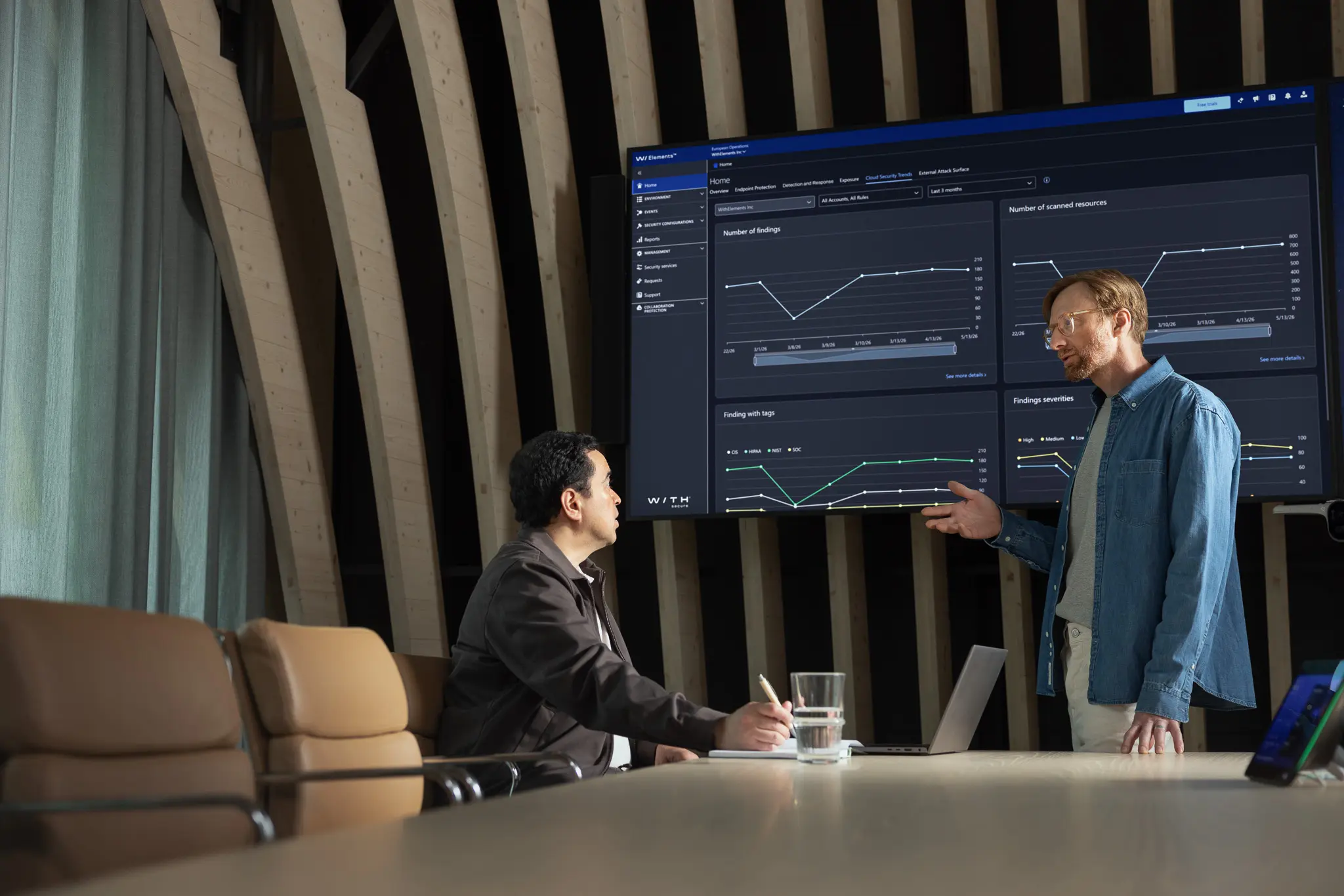
If you saw the headlines about PHP2Shell and wondered whether it affects you, you are not alone. The short answer: it might, and the fix is already available. What matters now is that someone checks.
This post explains what happened, what it means for a business like yours, and the one conversation worth having today.
What happened
On October 21, 2026, a patch was released for two serious flaws in PHP (CVE-2026-109618 and CVE-2026-109619). PHP is the software behind a large share of the internet’s websites and web tools. Both flaws are rated 9.2 out of 10 for severity. In plain terms, an attacker who can reach a vulnerable system over the internet may be able to run their own commands on it, without logging in.
National cyber authorities, including CISA, the Canadian Centre for Cyber Security and the UK NCSC, have issued alerts, and security vendors have reported exploitation attempts. That is a good reason to act promptly. It is not a reason to panic.
Why you might be affected without knowing it
You do not need to employ a developer to use PHP. It often sits quietly behind things like:
- Your company website, especially if it runs on WordPress or WooCommerce
- Your online shop or the admin side of your checkout
- Appointment booking or event registration
- Customer portals or software built for you by a local provider
If your customers can book, buy or log in on your website, there is a fair chance PHP is part of how it works.
What it could mean for your customers
A business website is often where customer names, orders and appointments are handled. If an attacker gets control of the system behind it, that information, and your customers‘ trust, can be at risk. This is why a flaw in a technical component becomes a business question, not only an IT one.
Who needs to do what
The good news is that you probably do not need to fix this yourself. Who acts depends on who looks after the system:
- Your IT provider (MSP) manages it. They apply the update. Ask them to confirm when it is done.
- A software vendor hosts it for you. The vendor applies the update. Ask them for a date.
- You or a colleague run it. The update is yours to apply, or to hand to someone who can.
Older systems need extra attention. Official fixes cover PHP 8.2 and later, so a website or application built on an older version may take more than a quick update. Some devices, such as firewalls, include PHP too, and their vendors may release updates later.
What to do this week
You do not need to understand the technical details. You need to ask one clear question of whoever looks after your IT:
„Do we run PHP anywhere, and has it been updated?“
A good provider answers with specifics: which systems, which versions, what is done and what is still open. If you get a vague answer, ask for a short written summary. It is a fair request, and a useful one before the next incident, not during it.
The bigger picture
There will be another flaw like this one. Next time it may not be PHP. What protects a business is not guessing which software is affected, but having a provider who already knows what you run and can tell you quickly. That is what good IT support looks like, and it is worth asking for.
Blog post
Read our latest blogs
Blog
Blog
Blog
Proactive Security: How MSPs can keep up with a 29-minute attack

There will be another PHP2Shell. It might be Java. It might be OpenSSL. It might be a library no one on your team has heard of.
The flaw changes. The first questions do not: What do we have? Is it affected? What is exposed? What goes first?
What exposure management does
WithSecure™ Elements Exposure Management (XM) gives you continuous visibility into exposures across on-premise assets, cloud services and digital identities. It helps you answer those questions before the advisory is a day old:
- Find the assets. Including the ones nobody listed.
- Identify vulnerable versions. So you know what is affected, not just what might be.
- Prioritize by exposure. By exploitability, attacker motivation and business impact, not by CVSS alone.
- Show it per partner. A clear view for each client, ready to share.
What it means for your MSP
One view across all your partners. A fast impact assessment when an advisory lands. A report you can hand to a partner without rebuilding it in a spreadsheet.
That is the difference between a scramble and a plan. You stay the hero. We stay the safety net.
What next?
Discover WithSecure™ Elements Exposure Management.
– No credit card required. No obligations.No complexity.
Blog post
Read our latest blogs
Blog
Blog
Blog
Proactive Security: How MSPs can keep up with a 29-minute attack

When PHP2Shell was published on October 21, the first question in most MSP channels was not „how do we patch?“ It was „where is it?“
The patch was the easy part. Finding every place that needed it was not.
Lesson 1: The inventory was not the environment
The CMDB listed what you deployed. The estate also held what partners built themselves: a campaign site from three years ago, a forgotten staging server, a booking tool installed by a cousin. Any of them can be reachable from the internet.
Lesson 2: Knowing the version is its own task
Distribution packages follow the vendor’s schedule, so sometimes you wait. Containers and self-compiled builds need separate checks. And PHP embedded in appliances may not show up in a package scan at all.
Lesson 3: Order matters
Internet-facing first, internal second. Pressure rose as public reproductions appeared. National cyber authorities, including CISA, the Canadian Centre for Cyber Security and the UK NCSC, issued alerts, and security vendors reported exploitation attempts. Amazon recorded one on October 17, four days before disclosure. In the AI era, the time between disclosure and exploitation keeps shrinking, so speed matters. Detection helps while you patch: WithSecure™ Elements EDR detects abuse of the vulnerability.
Lesson 4: Say what you are doing, and what it costs
Partners want to hear three things: what is affected, when it will be done, and how the work is priced. Be open about all three. Emergency patch work is real work, and a clear explanation protects the relationship. The MSP who knows first what runs at a partner is the one who gets the call next time.
Before the next one
A spreadsheet built during a crisis is out of date the next week. What works is continuous mapping of the external attack surface, so the answer to „where is it?“ is already waiting.
Blog post
Read our latest blogs
Blog
Blog
Blog